 Bean Toss Games and
Bean Books
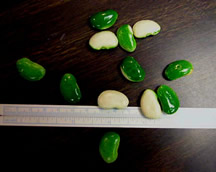 Preparation: To make the beans get a package of dry Lima beans, a box or newspaper, and a spray can of enamel paint.
Put the beans into a box or on a sheet of paper in a well ventilated area. Spread the beans out so they are separated and one side of each will be exposed to the spray. Lightly spray. It is best to spray a bit, stop, and check the results. It is easier to add more paint than deal with drips and blobs. When happy with the coat of paint, Let them dry.
When the beans dry, they are ready for learners to toss.
Practice making a book so you can teach students how to cut and fold their personal Bean Toss book.
Next select the number of beans you want to start with, to toss and prepare the appropriate Bean Toss fold book.
Fold books for different numbers of beans:
| one | two | three | four | five | six | seven | eight | nine | ten |
Sample fold book pattern:
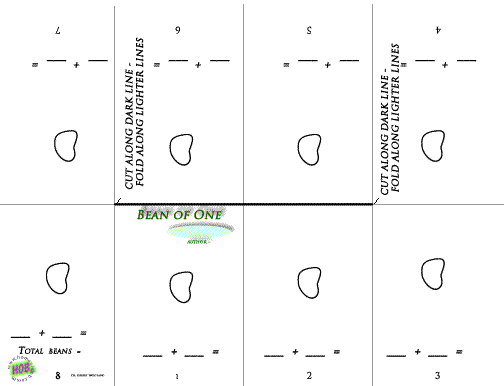
Directions:
- Crease the paper along all the fold lines and then unfold the page.
- Fold the page in half perpendicular along the dark line in the pattern (hamburger fold). Then cut a slit along the dark cut line in the middle. See pattern.
- Open the page and fold along the longer line (hamburger fold), that you cut along.
- Now is the tricky part. Fold along the line between page 5 and 6 so that page 5 and 6 will be back to back. At the same time fold page 1 and 2 along the fold line so that they will be back to back. This will require bending the paper by opening a hole where the paper was cut. As you look down on the fold from the top, it will look like a + sign.
- When you finish that fold and bend so page 7 will be back to back with page 8 and page 3 will be back to back with page 4.
- Fold them to complete the book and all the pages will be in order.
Explain how you want students to toss the beans, and and record the results in their books.
When they have completed their books, the fun and interesting part is to record the class results.
One fun way to do this is to give each learner eight sticky notes and have them write the numer of white and non white sides they got for each toss.
Prepare a board or wall with all the possible combinations. For example if they are tossing five beans, put the following on the board
Og 5w ...... 1g 4w ...... 2g 3w ...... 3g 2w ...... 4g 1w ...... 5g 0w
and have them stack their sticky notes above the matching outcome.
When the data is recorded on the chart they can look for patterns and make predictive and probability statements about the numbers and the sum total.
Enjoy!