Myths & Legends
Defined & described with quality examples by its story elements
Overview
Introduction
The page includes definitions of myths and legends. Different kinds of myths, their analysis, their story elements, and what makes myths and legends quality or less than quality.
Story elements - the characters, plot, setting, theme, and events are all framed as real life, although sometimes unlikely to be achieved by normal humans. Setting time is for all ages or every time, and plot problems are based on real life events.
Myths
Myth is a story with a traditional oral beginning that was used as an explanation in the early history of a culture.
Mythical explanations range in complexity from simple - why stories (pourquoi tales) to complex involved mythologies or legends that encompass the history and workings of an entire culture: The White Stallion - Magyar, Illiad - Greek Trojan war, ...
1. Direct cause and effect interaction that could be observed. Such as the reason bears have short stubby tails is
there long fluffy one got caught in the door of great great grandmother’s Camero as she sped off after dropping great grandma bear at school when she was a little girl.
2. Personification is a form of explanation where an animal or a force of nature acts as a human. An example is the myth that explains why spiders spin webs.
Arachne was a beautiful human spinner who mouthed off to Athena. As a result Athena turned Arachne into a spider for being too proud and lippy.
Another example is a myth about a human hunter who wandered off the face of the earth and can be seen still wandering through the heavens in the constellation Orion.
3. Gods do it. When a god or supernatural beings, which control of certain forces, have powers to take on a life of their own, interact with other gods or supernatural beings as well as humans in ways that extend beyond their domain.
- Zeus (protector and ruler of humankind)
- Demeter (goddess of cereal grain) daughter Persephone (daughter of Zeus and Persephone) story about her abduction by Hades as an explanation for seasons, growth, fertility…
4. Extend explanatory powers from concrete explanations to abstract virtues. The power of the sun god (Apollo) expands from driving the sun across the sky in a 67 Camero to being in control of giving life, health, happiness, purity, and wealth. This can extend into allegories. Midas can be an allegory for greed. How the force of greed can be represented as a human and the actions of Midas represent the actions of greed.
Legends
Legends are similar to myths. Often began as traditional narratives within a particular culture. They tend to have more historical information and less reliance on supernatural, e.g. King Arthur, and Robin Hood, Where the main characters are larger than life, superhuman in some ways, with exceedingly superior physical and moral qualities. They engage in quests and adventures that require great courage and virtue. Periodic supernatural intervention is likely. Point of view is third person with descriptions of actions with no internal narrative coming from the main characters.
Epics are also similar to legends only are long narrative poems.
Hero myths - don’t explain anything, they are just an epic wonder story with the hero having a quest, task, or riddle to complete.
Epics and Legendary heroes - A cycle or cluster of stories clustering around the actions of a single hero. They grew out of myths. Iliad, Odyssey, Gilgamesh, (668-626) Odysseus and Penelope represented the Greek ideal of intelligence, persistence, and resourcefulness. Beowulf, King Arthur, Robin Hood, Ramayana,
Explore myths and legends.
A unit of study using: The White Stag by Kate Seredy.
Quality characteristics of myths & legends by story elements
Characterization
- Characters are very few Animated, inanimate, or personified gods, goddesses, or humans with supernatural or god like traits.
- The gods or superheroes can take the form of human, but are immortal with super natural powers.
Setting
- Place is cultural relevant.
- Time is in the past long ago, but realistic time.
Plot
- The plot will most likely include plenty of drama, action, suspense, and basic conflict.
- May offer explanations about the beginnings of the world or natural phenomenon.
- May also focus on difficult tasks or obstacles to be overcome.
- Plot deals with relationships between humans and gods & goddesses & superheroes. The way people accept or fulfill their destiny, and human's struggle with god, goddesses, and evil forces both within themselves and outside themselves.
- Others plots tell how the world began, how people were made, how seasons change, animals have certain characteristics, how the moon, sun, and earth interact…
Mythology
- A collection or set of myths becomes a Mythology.
- A mythology can have a connected plot about an institution, situation, behavior, or happening that provides an explanation of power through force or energy in human form. With the force or energy used to control nature, people, or a complex situation. This control is traditionally exercised by gods with godly attributes.
- Attributes can be for good or bad: wise, foolish, love, hate, virtuous, evil, …
- In a more modern sense the beings may be superheroes.
Theme
- Simple, serious, and powerful.
- Explains natural phenomena, origins of life, human behavior, social phenomena, religious customs, human strengths, weaknesses or lessons for life.
Style
- Reflects abstract ideas about the culture's customs, values, and beliefs with little or no desciptions.
- Reflection of human strengths, frailities, weaknesses, or imperfections.
- Usually includes supernatural beings or events.
- Believe main character can survive all obstacles to achieve goal.
Tone
- Dignified, mystical ideas are presented in an assumed straight forward manner.
- Leads to new insights and/or understandings.
Point of View
- Often third person narrative.
- Omniscient, external, biased toward the gods and godesses
Greek & Roman gods with characteristics
| Greek | Roman | Duties and Responsibilities | Identifying Characteristics |
|---|---|---|---|
| Adonis | Spirit of spring; beloved of Aphrodite |
|
|
| Aphrodite | Venus | Goddess of love and beauty; son, Cupid | Chariot drawn by doves or swans |
| Apollo, Phoebus |
Apollo, Phoebus |
God of music, poetry healing; sun-god | Driving sun chariot; flute lyre |
| Ares | Mars | God of war | Full armor, long floating plume |
| Artemis | Diana | Sister of Apollo; goddess of the chase and of moon | Huntress with bow quiver, and arrow; chariot drawn by stags with golden horns |
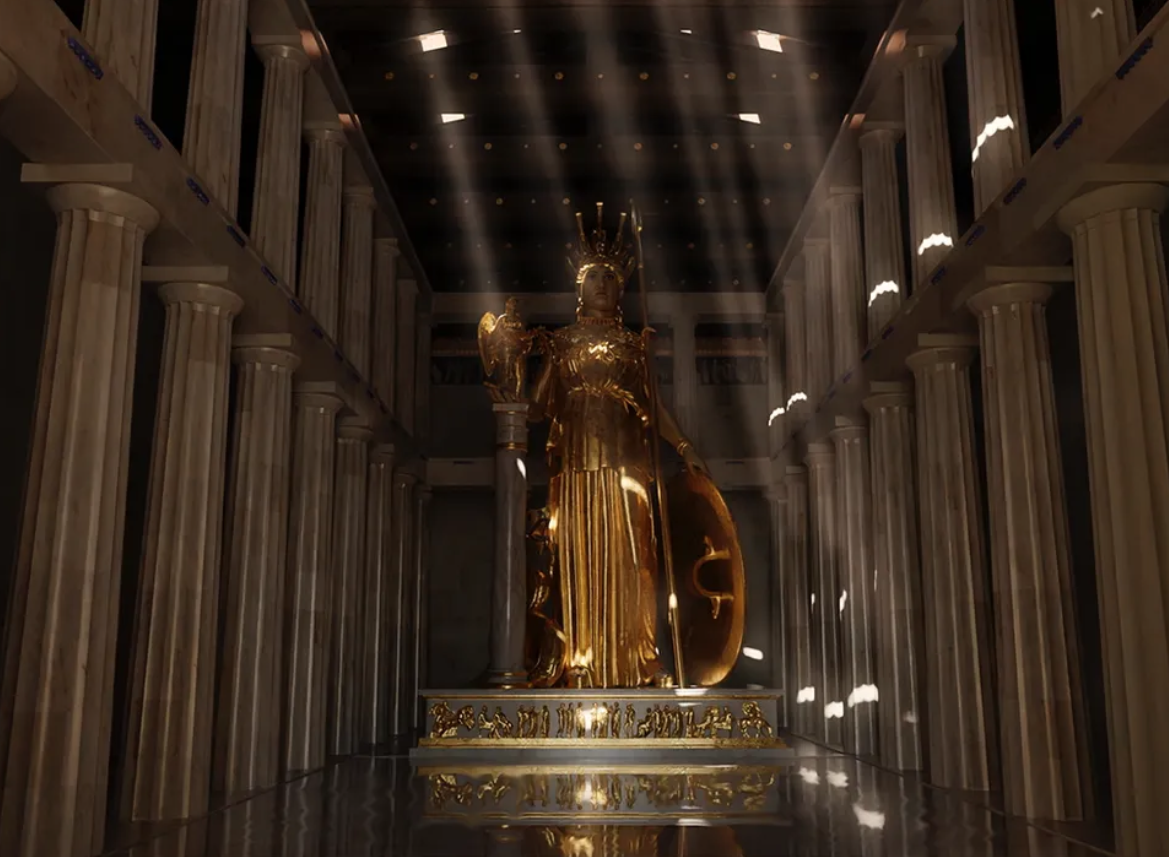
| Athena, Pallas | Minerva | Goddess of wisdom, protectress of household art | Helmet on head, staff and breastplate from which hung the Gorgon’s head |
| Atlas |
|
Titan condemned to uphold the world on his shoulders for fighting against Zeus |
|
| Cerberus |
|
Guarded the gates of Hades | Three heads and tail of a dragon. |
| Charon |
|
Ferry on the Styx |
|
| Daedalus |
|
Artificer and Architect; designed the labyrinth into which he was cast but escaped by means of artificial wings. |
|
| Demeter | Ceres | Goddess of the harvest | Garland of corn ears; in hands a scepter or cornucopia. |
| Dionysus | Bacchus | God of wine | Chariot draw by leopards; his head crowned with leaves in hand a staff entwined with ivy |
| Echo |
|
Nymph who pined away for the love of Narcissus until only her voice remained. |
|
| Epimethus |
|
Brother of Prometheus and husband of Pandora |
|
| Eros | Cupid | Son of Venus, god of love | Bow and arrow |
| Gorgons |
|
Daughters of a sea deity; snake locks, brazen claws, bodies covered with scales which no weapon could pierce; faces so terrible that beholder was turned to stone; Medusa alone was mortal |
|
| Hades or Pluto | Dis | God of the underworld and king of shadows |
|
| Hephaestus | Vulcan | God of fire and smith of the gods | Key to underworld in one hand and magic staff in other |
| Hera | Juno | Wife of Zeus, goddess of marriage |
|
| Heracles | Hercules | Earthly son of Zeus |
|
| Hermes | Mercury or quicksilver | Messenger of the gods; guardian of travelers |
|
| Icarus |
|
Son of Daedalus; his artificial wings melted when he flew too near the sun and he drowned in the sea; henceforth called the Icarian Sea |
|
| Olympus |
|
Mountain in Thessaly, home of the gods |
|
| Orpheus |
|
Son of Apollo, poetical singer and musician; attempted to rescue his wife, Eurdice from Hades |
|
| Pan | Faunus | God of things in nature | Bearded man with ears and hoofs, a goat; in his hands, a shepherd’s flute or crook. |
| Persephone | Proserpina | Daughter of Ceres and queen of the underworld |
|
| Perseus |
|
Son of Jupiter and Danae; cut out head of Medusa |
|
| Poseidon | Neptune | God of the sea | Trident, dolphin, hordes |
| Prometheus | Son of Trident and brother of Epimethus |
|
|
| Zeus | Jupiter or Jove | King of the gods and men | Eagle, thunderbolt and oak |
Names in Norse Mythology & Legends
| Name | Descriptions |
|---|---|
Aseir |
Collective names for gods who lived in Asgard |
Asgard |
City of the gods and goddesses |
Balder or Baldur |
God of happiness, sunlight, and spring |
Bifrost |
The rainbow bridge connecting Midgard (earth) and Asgard |
Dwarfs |
Earth-like human beings, magic artisan; made Odin's spear and Thor's hammer |
Frey |
God of the weather and of harvest |
Freya |
Goddess of love and beauty, sister of Frey |
Frigga or Frigg |
Wife of Odin, goddess of the household |
Giants |
Enemies of the gods and men; dwellers in Jotunheim; personifying Scandinavia's cold snow and ice |
Heimdall |
Guard of the rainbow bridge against giants |
Hel or Hela |
Goddess of death |
Hoder or Hod |
Blind god, twin brother of Balder |
Hoenir |
Odin's brother, who helped create the first man |
Hymir |
Giant from whom Thor obtained a kettle |
Idun or Iduna |
Goddess of spring and youth |
Loki |
God of mischief and destruction |
Midgard |
Earth, abode of mankind |
Mimir |
All-wise giant to whom Odin gave an eye for wisdom-giving water |
Miolner |
Thor's magic hammer (thunderbolt |
Nanna |
Balder's wife, flower goddess |
Skymir |
Giant who directed Thor to Utgard |
Sleipnir |
Odin's eight-legged horse, speedier than the wind. |
Thialfi |
Thor's servant |
Thiassi |
Frost-giant who could change himself into an eagle |
Thor |
God of thunder, friend and protector of men |
Thrym |
King of the frost-giants; stole Thor's hammer |
Tyr |
God of war, patron of sports |
Valhalla |
Gold-roofed hall in Odin's palace for souls of heroes slain in battle, brought from earth by the Balkyries, Odin's messenger |
Yggdrasil |
Tree great enough to uphold the universe |
Ymir |
Progenitor of the race of giants; slain by Odin and his brother, who made earth, sea, and sky out of his body. |
Home: Literacy, media, literature, children's literature, & language arts